Name: Nicole Michel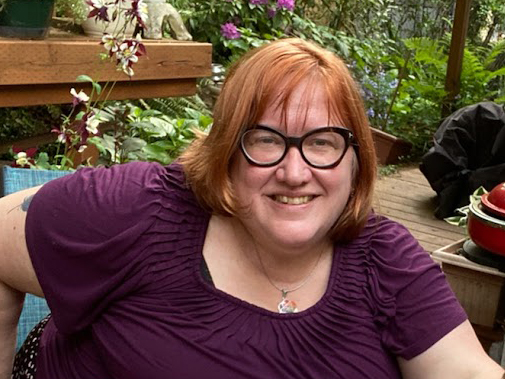
Current Job: Senior Quantitative Ecologist
Scientific Discipline/Field: Bird conservation
Country: United States
Pick some letters (L,G,B,T,Q,+, etc.): I identify as queer, but more specifically I’m closer to B (bisexual)
Website (personal, work, ORCID, – you don’t have to put one down): https://www.researchgate.net/profile/Nicole_Michel
Twitter or other social media handle (if applicable): @Nicole_Michel
What does your job involve?
I lead a team of quantitative ecologists who analyze data to inform conservation of birds and their habitats. When I started I was the only quantitative ecologist at my organization, so I spent most of my time doing actual coding and analysis. We work on a wide range of projects at any given time, including analyses of long-term population trends from datasets like the Christmas Bird Count (120 years and counting!), analyses of bird response to climate and land use change, and spatial prioritizations to identify the most important areas for conservation. I also have developed several metrics to evaluate bird response to conservation and management actions, which is exciting because it enables us to be accountable in our conservation efforts. We’re currently working on developing a really cool new project that will help us identify the most important places for birds across their annual cycles. As a manager I still get to “geek out” with the coding, but much more of my time is spent on calls with my team, with colleagues across the organization, and collaborators beyond the organization to build and maintain relationships, offer scientific and monitoring advice, drum up work, write grants, and promote my team’s work. Prior to COVID-19 I travelled frequently – often 2-3 times a month – but that has come to a halt now and been replaced with more Zoom meetings and conferences.
How did you get to this job (education etc.)?
I received a Bachelor’s degree in Biology with an Environmental minor and knew at the time that I wanted to do work that let me use science to inform conservation. But I had gone to a small liberal arts college and graduated in the mid-1990s when the internet was brand new, so I had no clue that these kinds of jobs existed. I ended up joining the AmeriCorps for a year and ended up in a fantastic program that gave me lots of different experiences, from habitat restoration to education to my favorite – research. A government biologist happened to loan me her copy of the Ornithological Newsletter (still printed and mailed then), and I was amazed at all the exciting field job opportunities. That led me to a series of field jobs that eventually turned into a full-time job with a bird conservation nonprofit, The Institute for Bird Populations. I spent six great years split between the office and the field, and learned a wide range of skills from coding to writing to GIS to teaching, but realized that the work I really wanted to do required a PhD. So I went back to school at 32 to get my PhD, from there to two post-doctoral positions, and finally to my current position.
Do you feel being LGBT has affected your career decisions?
I don’t think so. Until recently, most of the people I openly dated were opposite-gender and I rarely discussed my identity, so I’m well aware of the passing privilege I had. Because of that, I was able to do work in foreign countries or even parts of the US that would have been more challenging had I been out.
Have you had any reactions from colleagues about being LGBT, either good or bad?
I’ve been fortunate in that most people took it in stride. A few people took my coming out as an opportunity to ask questions that were more personal/invasive than I felt were appropriate for our relationship, but thankfully they were not people in a position of power over me.
Did you have any role models growing up (LGBT, STEM, totally unrelated…)?
My father and grandfather sparked my interest in STEM generally and birds specifically, but I didn’t know any actual living scientists growing up. I grew up watching Jacques Cousteau and reading National Geographic, but had no idea people could actually make a living doing this work. I wasn’t aware of any LGBTQ+ people in my world until high school, when a friend came out. I had a very sheltered suburban childhood!
What are your plans for the future?
I want to keep working to conserve birds, their habitats, and their communities using the best available science. At the same time, I want to help make STEM – and the broader world – a more diverse, welcoming and inclusive place for LGBTQ+ and POC.
Anything else you’d like to add?
Thanks for creating this space!
 LGBTQ+ STEM
Leave a comment